Metal Roof Surveys
Metal Roof Surveys
There are a number of types of metal roof that are commonly found throughout the UK. These days most are steel profiled roofs, but there are still many examples of standing seam aluminium roofs in existence.
New industrial and commercial premises tend to be built with composite roof systems, where a layer of insulation is bonded between an inner metal and outer metal profiled sheet.
Older steel profile roofs and over-cladded roofs tend to comprise an inner liner sheet, a vapour barrier to avoid condensation issues, in insulation layer and the external profiled sheet.
Over time, steel profiled roofs can develop problems with corrosion at the cut edges. This is known as “cut edge corrosion” and is probably one of the biggest issues affecting built-up metal roofs. It is not unknown to occur on composite steel roofs, but is less common simply because composite roofs tend to be of more recent construction.
The majority of profiled steel roofs are coated with Plastisol, a flexible platicised paint that is instantly recognisable by its leather grain finish.
Others are coated in PVDF, also referred to as PVF2, which is a flourocarbon coating which is applied on top of a primer to galvanised steel or Aluzinc, a hybrid aluminium and zinc substrate.
Around 90% of all metal roofs installed in the UK are Plastisol faced.
The Importance of Safe Access
If it is safe to do so, the surveyor will walk the roof in order to be able to examine the surface as closely as possible.
This allows the surveyor to examine any defects that might be present and determine whether butyl seals are present between overlapping roof sheets, look at the condition of fixings etc.
When working at height, even on something solid like a metal roof, extreme care must be taken, because there are multiple risks present, such as;
- Fragile roof lights
- Pinholed roof sheets due to corrosion
- Moss & lichen, which can be slippery when wet
- Blacked out or moss-covered roof lights
- Failing structural members
- Steepness of the roof
Camera poles, drones and cherry pickers can be utilised, but nothing really beats being close up and personal.
Whenever we conduct metal roof surveys, a site-specific risk assessment is carried out.
What We Look For
The roof surveyor will be looking firstly at the most commonly troublesome areas.
In order, this is likely to be GRP roof lights, gutters, cut edges of the profiled sheets, fixings and then the factory finish.
GRP roof lights deteriorate over time, often losing their protective gel coat finish due to Ultra Violet (UV) exposure. This makes the surface brittle and they can become easily damaged by birds or other mechanical means.
Gutters often suffer from a lack of maintenance and soil, fungal growth and debris is allowed to accumulate within. This can block the gutter, causing it to overflow. In the case of a valley gutter, water ingress is highly likely when water cannot escape from the gutter.
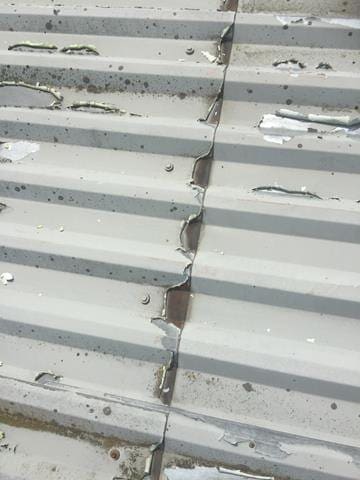
Cut edges. Cut edge corrosion is common. It begins with the factory finish (usually Plastisol), peeling back from the bottom edges of the metal roof sheet. This exposes the substrate to the elements and corrosion begins to take hold on the top of the roof sheet. If left, it can cause significant damage.
Even a thick coating like Plastisol can degrade with UV light and often, fading, chalking and crazing of the Plastisol (or other coatings) will be evident. If not arrested, the roof can lose the majority of its protective coating in a relatively short period of time, which can result in more damage to the substrate.
Survey Reports and Remedies
A roof survey includes a thorough report, backed up with a large portfolio of photographs, detailing areas of disrepair and commenting on the condition of the roof being surveyed.
If a drone is used during the roof survey, it is likely that in addition to the photographs, high quality video footage will also be included.
As well as highlighting any defects that are present on the roof, the report will also contain a number of options for the client to effect a repair.
In severe cases, a recommendation might be made to replace or over-clad the roof, but in most cases, wholesale replacement is not required.
The report aims to inform the client of what is wrong and what actions can reasonably be taken to put things right. This section will also include approximate budget costs for each option.
If required, at additional cost, a specification for any recommended works can be compiled and the works tendered to competent roofing contractors to crystallise the actual cost of the proposed works.
We are also able to act as Contract Administrators and project manage large roof works from specification to project delivery, based on a percentage of the cost of the works.
CUT EDGE CORROSION ON METAL ROOFS
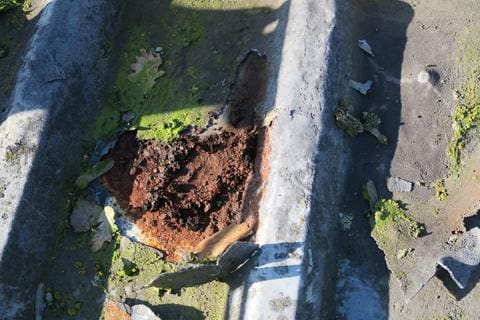
This is spot corrosion present in the middle of a metal roof sheet. Spot corrosion usually occurs when something damages the original factory finish and is not repaired. As the corrosion takes hold, the factory finish deteriorates further and eventually the rust will eat through the roof sheet.

A butyl sealing strip should be present at the mid-lap joints on metal profiled roofs. We inspect these to see if the seal is present or not, or if it’s perished with age and use. If the seal is not present, wind-driven rain can enter the joint.
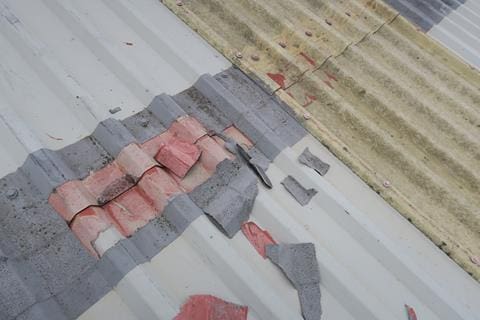
Some roofing surveyors dig deeper than others. This isn existing cut edge corrosion treatment that was primed with a red oxide paint, the overlapping sheets were sealed and then overcoated. We can see from the staining that’s evident, that trapped water was present and this can cause underside corrosion.
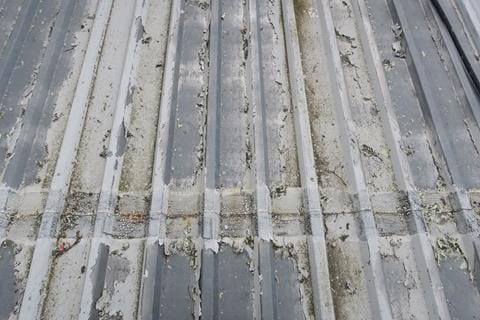
Treating cut edge corrosion without fixing the issue of the delaminating factory finish, can lead to even greater, but hidden cut edge corrosion problems, as water can track down the roof sheets, underneath the factory finish, becoming trapped by the cut edge corrosion treatment. In some case, the cut edge corrosion treatment is rendered useless.
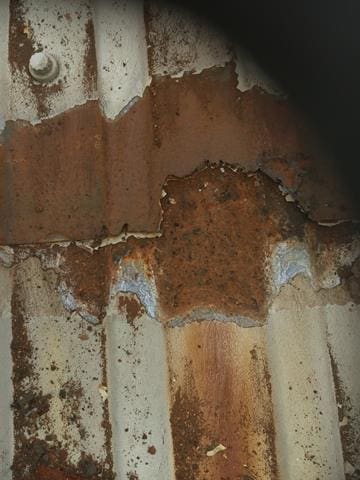
This is an example of what happens when cut edge corrosion is ignored. The rust has extended to the fixing line and at the cut edge, has rotted away completely. The bottom sheet is also affected, which can occur when the gap between the overlapping roof sheet has been sealed.
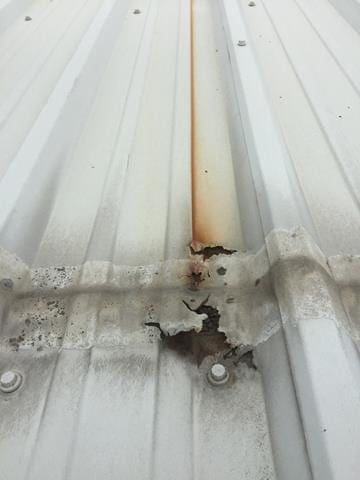
An existing cut edge corrosion treatment on a metal roof should always be examined for signs of damage, or failure. In this case, can see that despite the cut edge corrosion having been treated, the rust has continued to develop beneath the treated surface.
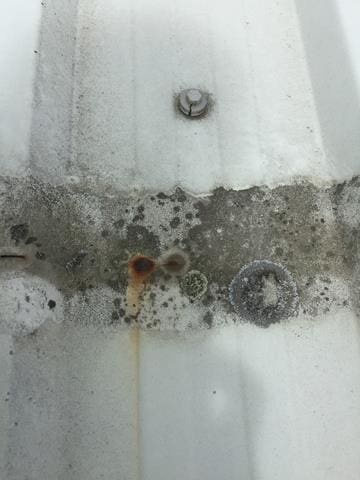
Tell-tale rust spots on a cut edge corrosion treatment. Many surveyors miss these, or believe that they are simply an indication that treatment requires over-coating. This rust spot is in fact, hiding a far more serious problem that requires immediate attention.
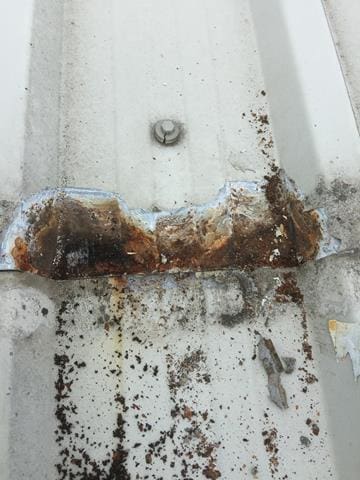
Compare this image to the previous image showing the rust spot. It is the exact same position on the roof, but the surveyor scraped away the existing cut edge corrosion treatment. You can clearly see that the rust spot is far larger than originally thought!
METAL ROOF FIXINGS

If a metal roof is experiencing leaks, it can be useful to pressure test a selection of fixings, as loose fixings or degraded washers can be a source of water ingress. This is something that we conduct as standard during our metal roof surveys.

A visual inspection of the fixings is important, especially when the plastic protective caps are missing. In this case, the top of the fixing is corroded and the sealing washer has degraded. The damage to the roof finish can be an indication of over-tightening.

When roofs are trafficked, the flex in the sheets and sundry panels (in this case the ridge detail), can become dislodged, leaving the roof vulnerable to leaks. Even though in this case, the holes are on the ridge line, the evidence of the leak internally, we much lower down the roof.

A common occurrence on metal profiled roofs. In this case, a discarded fixing in the gutter, which, if trafficked, could easily penetrate the single-ply gutter liner. Regular maintenance of the gutters should be undertaken to ensure such debris is not present.
ROOF LIGHTS
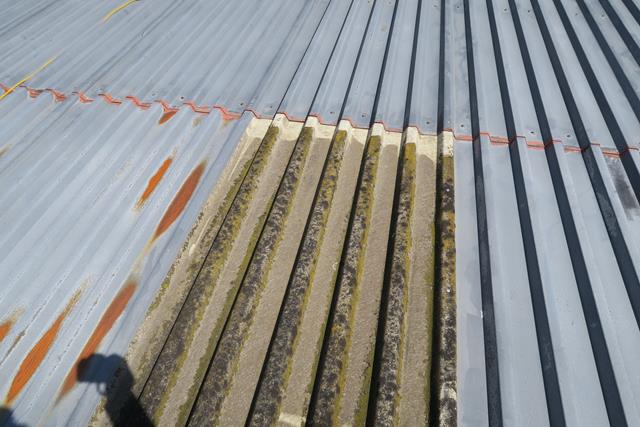
This is a GRP roof light at the commencement of a cleaning exercise using jet wash equipment. The surface of the roof light was degraded and the original factory finish gel coat was missing, making the glass fibres visible.
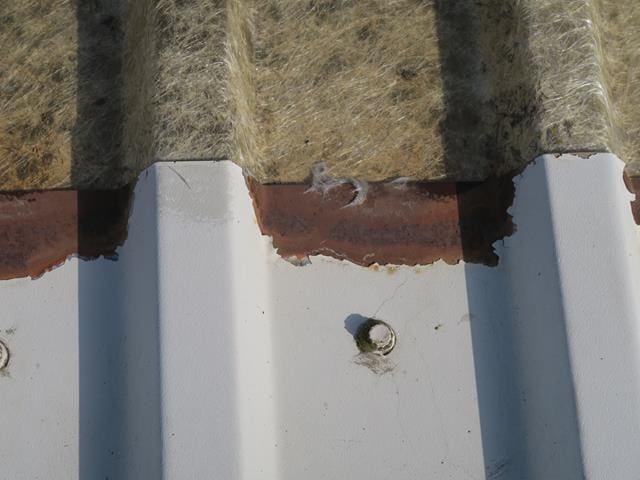
The GRP roof light in this image shows that the gel coat has degraded to the point where it is now “feathering.” Where feathering is present, it is a sign that the roof light is beyond it’s economical and serviceable life and requires replacement.
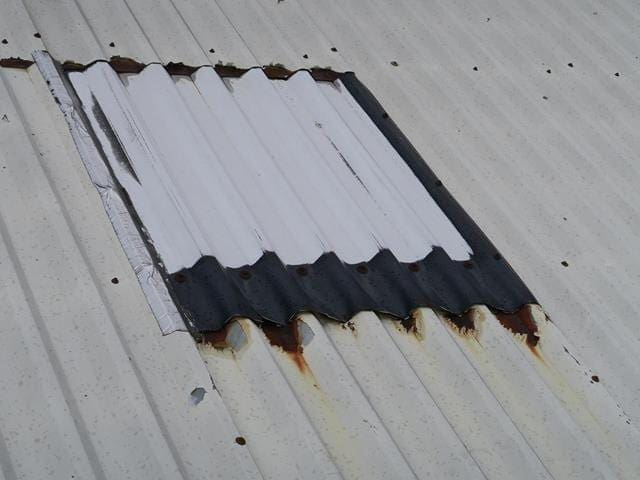
This is a PVC roof light with a poor quality repair evident. Flash band tape has been applied to the left hand side and bitumen tape applied to the right hand side and bottom of the profile. Repairs of this nature can only be considered to be temporary – meaning 3 months at most.
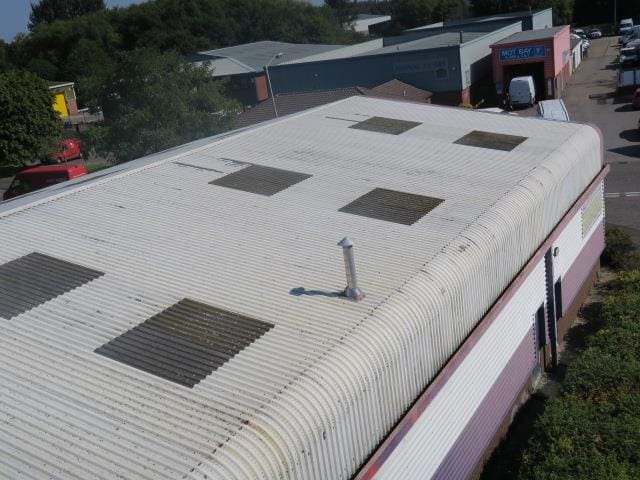
GRP roof lights become soiled over time. This reduces their translucency and results in less light entering the building. Sometimes, roof lights can be cleaned, but should first be examined for the presence of holes, cracks and poor quality repairs.
PEELING SUBSTRATE
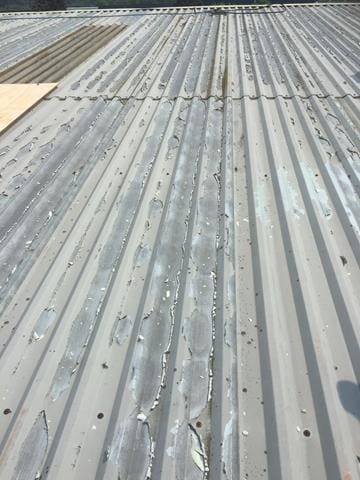
If a metal roof is not properly maintained, exposure to UV light and weathering will eventually cause the factory finish to chalk and craze.
If this is ignored, the surface of the factory finish will begin to peel away from the substrate.
Eventually, the galvanised substrate will deteriorate and the surface will become corroded.
The first sign of this is white corrosion – a chalky looking appearance which becomes more widespread as the roof ages.
When the surface is affected in this way, the substrate can soon become pinholed, which severely affects the structural integrity of the roof sheets.
If the factory finish to these roof sheets is seen to be peeling extensively, it is worthwhile examining the underside of the roof sheets to examine the cut edges for signs of underside corrosion.
If corrosion is present to the underside, it is likely that the roof will need over-cladding or complete replacement.
If the condition of underside of the roof sheets remains intact, with no corrosion present, the roof can be re-coated.